Macedonian History: The Chryselephantine Shield from the Tomb II (Aigai/ Vergina) bearing the Greek Maiandros in Macedonia, Greece
From the data at our disposal at present, we know that the Macedonians worshipped the twelve Olympian gods, both collectively and individually, and also Pluto, Persephone, Dionysos, Pan, Hestia, Heracles, Asklepios, Okeanos, Amphitrite, the Nereids, Thetys, Orpheus, the Diocouroi, Amphilochos, the Nymphs, the Graces, the Fates, Hygieia, Lethe, Nemesis and Eros. They also gave them the familiar Greek epithets, such as Agoraios, Basileus, Olympios, Hypsistos of Zeus, Basileia of Hera, Soter of Apollo, Hagemona and Soteira of Artemis, Boulaia of Hestia, etc.
Some to the evidence for the worship of Ge, Helios, Dionysos, Pan, Asklepios and Heracles is earlier than the period of Philip, while the earliest evidence for the twelve gods from this period. The large number of these god’s names and the early date of the evidence militates against the false argument advanced by those opposed to the idea that the Macedonians were Greeks.
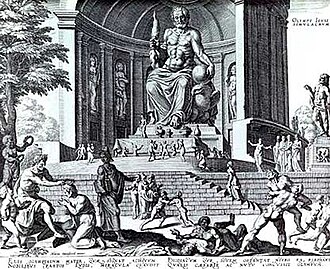
The Macedonians were particularly devoted to Zeus, father of Makedon (Μακεδών), their eponymous ancestor, and to Heracles, held to be the progenitor (Ηρακλής προπάτωρ) of the Argead clan as well as of the later Antigonid dynasty. Notable are the cults of Zeus Hetairides (Εταιρίδης), who presided over the relationship of the Argead kings with their aristocratic Companions (εταίροι) and who gave his name to the festival of the Hetairideia. Heracles Kynagidas (Κυναγίδας) was worshipped as the patron of hunting, a sport to which the Macedonians were passionately attached. Heracles Kynagidas was also presiding over the Royal Huntsmen (βασιλικοί κυνηγοί) as well as over the kings’ game preserves.
Established custom required the king personally to conduct many rites and sacrifices. Among these two of the most important were: (a) the formal purification of the army performed each at the festival of the Xandica (Ξανδικά) held in the early spring, at the beginning of the campaigning season, though this purification could be performed at other times as well; and (b) the overseeing of the ceremonial interment of the Macedonian dead post-combat.
Cult figures, largely Thracian and indigenous to the regions occupied by the Argead Macedonians, continued to be worshipped along side the Macedonian religion. We have, for instance, the water-air spirit that gave its name to Edessa, an old town famous for its springs and situated near Aigai, the earliest residence of the Macedonian kings. Meanwhile, the reverence accorded to Sileni (σαυάδαι) and Bacchae (Κλώδωνες and Μιμαλλόνες) indicates a prevalence of Dionysus-Sabazius worship.
In addition the names of the twelve Macedonian synodic lunar months depict Greek names used in various parts of Greece:
Dios (moon of October)
Apellaios (moon of November)
Audnaios (moon of December)
Peritios (moon of January)
Dystros (moon of February)
Xandikos or Xanthikos (moon of March)
Artemisios or Artamitios (moon of April), also a Spartan, Rodian and Epidaurian
month)
Daisios (moon of May)
Panēmos or Panamos (moon of June), also an Epidaurian, Miletian, Samian and
Corinthian month
Loios (moon of July), also an Aetolian, Beotian and Thessalian month
Gorpiaios (moon of August)
Hyperberetaios (moon of September), Hyperberetos was a Cretan month.
The Hellenistic and Roman imperial periods show few developments peculiar to Macedonia. By the end of the third century BCE the Egyptian gods had been widely received, and the cult of the Syrian Goddess was established at Beroia. Documented evidence does not as yet attest to the worship of Zeus Hypsistos (‘Ύψιστος) before the second century, but the cult may well have arisen earlier. In the Roman period and above all at Thessalonice, the cult of Dioscuroi-Cabiroi, which derives from Samothrace, was most successful. In addition, the cult of Ma of Cappadocia was known to be found at Edessa in the third century A.D; and from the late Hellenistic period down to the triumph of Christianity the Thracian Rider (‘Ήρως or Ήρων) was the object of widespread devotion, particularly in connexion with the burial of the dead. By way of conclusion, elements that are unquestionably Greek are much more numerous than those which are not Greek. The great majority of the Greek elements is earlier in date than the non-Greek. These observations show that the Macedonians were not Thracians or Illyrians or any other race that became Hellenised, but Greeks whose culture was slightly influenced by non-Greek features.
by Dr Kostas Vitkos and Mr Iakovos Garivaldis (Published first in “Athena” journal, iss.14, Melbourne 2006, of the Society for Ancient Hellenic Studies, www.sahs.com.au)
Macedonian History: Zeus was the father of Makedon (Μακεδών), the eponymous ancestor of ancient Macedonians
[1] Quote:
| Having settled these affairs, he returned into Macedonia. He then offered to the Olympian Zeus the sacrifice which had been instituted by Archelaus, and had been customary up to that time; |
(Arrian Anab. I 11.1)
[2] Quote:
| It is said he [Alexander] also held a public contest in honour of Muses |
(Arrian Anab. I 11.2)
[3] Quote:
| when he was about the middle of the channel of the hellespont he sacrificed a bull to Poseidon and the Nereids and poured forth a libation to them into the sea from a golden goblet |
(Arrian Anab. I 11)
[4] Quote:
| they say also that he was the first man to step out of the ship in full armour on the land of Asia, and that he erected altars to Zeus, the protector of people landing, to Athena and to Heracles |
(Arrian Anab. I 11.6)
[5] Quote:
| Philip, after this vision, sent Chaeron of Megalopolis to consult the oracle of Apollo at Delphi, by which he was commanded to perform sacrifice, and henceforth pay particular honour, above all other gods, to Zeus; |
(Plutarch, The life of Alexander)
[6] Quote:
| He [Alexander he Great] erected altars, also, to the gods, which the kings of the Praesians even in our time do honour to when they pass the river, and offer sacrifice upon them after the Greek manner. |
(Plutarch, The life of Alexander)
[7] Quote:
| Along with lavish display of every sort, Philip included in the procession statues of the twelve Gods brought with great artistry and adorned with a dazzling show of wealth to strike awe to the beholder, and along with these was conducted a thirteenth statue, suitable for a god, that of Philip himself, so that the king exhibited himself enthroned among the twelve Gods. |
(Diodorus Histories, Chapter 16, 95.2)
[8] Quote:
| He (King Philip) wanted as many Greeks as possible to take part in the festivities in honour of the gods, and so planned brilliant musical contests and lavish banquets for his friends and guests. Out of all Greece he summoned his personal guest-friends and ordered the members of his court to bring along as many as they could of their acquaintances from abroad. |
(Diodorus Histories, Chapter 16, 91.5-6)
[9] Quote:
| The future prosperity [of the historical general] Seleukos was foreshadowed by unmistakable signs. When he was about to set forth from Makedonia with Alexandros [the Great], and was sacrificing at Pella [in Makedonia] to Zeus, the wood that lay on the altar advanced of its own accord to the image and caught fire without the application of a light. |
Pausanias, Guide to Greece 1.16.1
[10] Quote:
| Delos would win the foremost guerdon from the Mousai, since she it was that bathed Apollon, the lord of minstrels, and swaddled him, and was the first to accept him for a god. Even as the Mousai abhor him who sings not of Pimpleia [town in Pieria/Macedonia sacred to the Mousai] so Phoibos abhors him who forgets Delos. |
Callimachus, Hymn IV to Delos 3
[11] Quote:
| They say that afterwards [the establishment of a shrine to three Mousai on Mount Helikon in Boiotia] Pieros, a Makedonian, after whom the mountain in Makedonia was named, came to Thespiae and established nine Mousai, changing their names to the present ones |
Pausanias, Guide to Greece 9.39.3
[12] Quote:
| Speaking of Alexander the Greatʼs luxury, Ephippus of Olynthus in his book On the Death of Hephaestion and Alexander says that in the park there was erected for him a golden throne and couches with silver legs, on which he sat when transacting business in the company of his boon companions. And Nicobule says that during dinner every sort of contestant exerted their efforts to entertain the king, and that in the course of his last dinner Alexander in person acted from memory a scene from the Andromeda of Euripides, and pledging toasts in unmixed wine with zest compelled the others also to do likewise. Ephippus, again, says that Alexander also wore the sacred vestments at his dinner parties, at one time putting on the purple robe of Ammon, and thin slippers and horns just like the gods, at another time the costume of Artemis, which he often wore even in his chariot, wearing the Persian garb and showing above the shoulders the bow and hunting-spear of the goddess, while at still other times he was garbed in the costume of Hermes; on other occasions as a rule, and in every-day use, he wore a purple riding-cloak, a purple tunic with white stripes, and the Macedonian hat with the royal fillet; but on social occasions he wore the winged sandals and broad-brimmed hat on his head, and carried the caduceus in his hand; yet often, again, he bore the lionʼs skin and club in imitation of Heracles. What wonder that the Emperor Commodus of our time also had the club of Hercules lying beside him in his chariot with the lionʼs skin spread out beneath him, and desired to be called Hercules, seeing that Alexander, Aristotleʼs pupil, got himself up like so may gods, to say nothing of the goddess Artemis? Alexander sprinkled the very floor with valuable perfumes and scented wine. In his honour myrrh and other kinds of incense went up in smoke; a religious stillness and silence born of fear held fast all who were in his presence. For he was hot-tempered and murderous, reputed, in fact, to be melancholy-mad. At Ecbatana he arranged a festival in honour of Dionysus, everything being supplied at the feast with lavish expense, and Satrabates the satrap entertained all the troops. |
Ath. Deipn. Book XII. 537 d – 540 a
[13] Quote:
| Concerning the professional “companions” Philetaerus says this in The Huntress: “No wonder there is a shrine to the Companion everywhere, but nowhere in all Greece is there one to the Wife.” But I know also of a festival, the Hetairideia, celebrated in Magnesia, not in honour of these “companions” (hetaerae) but for a different reason, which is mentioned by Hegesander in his Commentaries, writing thus: The Magnesians celebrate the festival of the Hetairideia. They record that Jason the son of Aeson, after gathering the Argonauts together, was the first to sacrifice to Zeus Hetaireios* and that he called the festival Hetairideia. And the kings of Macedonia also celebrate with sacrifices the Hetairideia. |
Ath Deipn. Book XIII. 572 d – e
[14] Quote:
….but there is an inscription at Dium in Macedonia, saying that he was killed by lightning, and it runs thus:Here the bard buried by the Muses lies,
The Thracian Orpheus of the golden lyre;
Whom mighty Zeus, the Sovereign of the skies,
Removed from earth by his dread lightning’s fire. |
Diogenes Laertius 1.8
[15] Quote:
| and he [alexander] demonstrated the strength of his contempt for the barbarians by celebrating games in honour of Asclepius and Athena.” |
(Curtius Rufus 3, 7, 3)
[16] Quote:
| “he consecrated three altars on the banks of the river Pinarus to Zeus, Hercules, and Athena,…” |
(Curtius Rufus 3, 12, 27)
| [17] Quote: |
| Criminals cannot get to sleep because their consciences will not let them; They are hounded by the Furies [Erinyes] not just after commiting a crime but even after planning one. |
Curtius 6.10.14
| [18] Quote: |
| Never more alarmed, Alexander had Aristander summoned to offer oews and prayers. Dressed in white and with sacred boughs in his hand and his head veiled, Aristander led the king in prayers as the latter solicited the aid of Zeus and Athena Nike. |
Curtius 4.13.15
| [20] Quote: |
| Alexander sent a rider ahead to tell them to go back and await his coming. Arriving on the scene, he offered sacrifices to Athena Nike and then restored Sisimithres’ rule to him. |
Curtius 8.2.32
| [21] Quote: |
| Although his victory was over the terrain rather than the enemy, the king nonetheless fostered the belief that he had won a decisive victory by offering sacrifices and worship to the gods. Altars were set up on the rock in honour of Athena Nike |
Curtius 8.11.24
[22] Quote:
| The people of Lampsacus favoured the cause of the Persian king, or were suspected of doing so, and Alexander, boiling over with rage against them, threatened to treat them with utmost rigor. As their wives, their children, and their country itself were in great danger, they sent Anaximenes to intercede for them, because he was known to Alexander himself and had been known to Philip before him. Anaximenes approached, and when Alexander learned for what cause he had come, they say that HE SWORE BY THE GODS OF GREECE, WHOM HE NAMED that he would verily do the opposite of what Anaximenes asked |
Pausanias [6.18.3]
[23] Quote:
| “Alexander (the Great)… after talking to the Thessalians and the other Hellenes,… grabbed his spear with his left hand, shifted his right hand to pray to the gods, as Kallisthenes reports, wishing, if he is indeed a SON of ZEUS that they SUPPORT the HELLENES. Aristandros, the priest…” |
(Plutarchos, Alexander 33)
[24] Quote:
| This is a sworn treaty made between us, Hannibal the general, Mago, Myrkan, Barmokar and all other Carthaginian senators present with him, and all Carthaginians serving under him, on the one side, and Xenophanes the Athenian, son of Kleomachos, the envoy whom King Philip, son of Demetrios, sent to us on behalf of himself, and the Macedonians and allies, on the other side. `In the presence of ZEUS, HERA and APOLLO; in the presence of the Genius of Carthage; …and in the presence of all the gods who possess Carthage; and in the presence of ALL THE GODS who possess Macedonia AND THE REST OF HELLAS; and in the presence of all the gods of the army who preside over this oath. Thus said Hannibal the general and all the Carthaginian senators along with him and the Carthaginian soldiers: ..That King Philip and the Macedonians AND the REST OF THE HELLENES who are their allies shall protect the Carthaginians,… King Philip and the Macedonians AND the OTHER HELLENES who are their allies shall be protected and guarded by the Carthaginians…” |
(Polybios 7.9.1-7; Treaty of alliance between king Philip V of Macedonia and Hannibal)
[25] Quote:
| Most admirable philosophy! which induced the Indians to worship the Grecian Deities…On the Fortune or the Virtue of Alexander, I, 5 |
[26] Quote:
| But Alexander engaged both Bactria and Caucasus to worship the Grecian Gods, which they had never known before. |
On the Fortune or the Virtue of Alexander, I, 5

 όνομα "Yuna Takabara". Yuna σημαίνει
Ίων
όνομα "Yuna Takabara". Yuna σημαίνει
Ίων